


ArtPix 3D Editorial Team · Updated July 2026 · 6 min read
The message is written and the pen is still in your hand, because how to sign a sympathy card turns out to be the part that stops people. Too formal reads as distant. Too warm reads as presumptuous if you only knew them through work. And the family will read this line while opening forty other cards, which is exactly why the wrong closing gets noticed. This guide gives you thirty closings ranked from formal to close, what to write in the line above your name, and how to sign for a couple, a family or a workplace. Use our guide if you want to know what to write in a sympathy card.
Quick answer: The best way to sign a sympathy card is to match the closing to how close you were to the family, not to how sad you feel. Of the 30 closings below, "With deepest sympathy" and "With love" are the 2 safest: the first works when you barely knew them, the second when you did. Use your full name if the family may not immediately place you. Sign for your household only if everyone in it knew the person who died. Signing for work, add your department.
Thirty ways to sign a sympathy card, formal to close
Pick from the group that matches your actual relationship to the family. Every closing for a sympathy card below can be written exactly as it appears, above whatever message you have written in the card.
Formal: for a business relationship, or when you barely knew them
- "With deepest sympathy,": the safest closing in the language. Never wrong.
- "With sincere sympathy,": a shade warmer than deepest, and less used.
- "With heartfelt condolences,": formal without being cold.
- "Please accept my condolences,": works when the card is the only contact you will have.
- "With sympathy from all of us,": for a team or department signing together.
- "Our sincere condolences,": plural, for a business.
- "Respectfully,": for someone senior you knew only professionally.
- "With sympathy and respect,": when you admired them and want to say so briefly.
- "Thinking of your family,": softens a formal card without overstepping.
- "With condolences,": short, correct, unremarkable in a good way.
Warm: for friends, colleagues you like, extended family
This group is how to sign a sympathy card to a friend, a colleague you like, or extended family.
- "Thinking of you,": the most useful two words on this page.
- "Thinking of you all,": when it reaches the whole household.
- "With warmth and sympathy,"
- "With care,": plain and unfussy.
- "With love and sympathy,": bridges warm and close.
- "Holding you in my thoughts,"
- "Here if you need anything at all,": only write this if it is true.
- "With you in this,"
- "Wishing you strength,"
- "With affection,": older-fashioned, and lands well with older recipients.
Close: for people you love
This is also how to sign a sympathy card for the loss of a mother or a father of someone close to you: warmth is expected there, and distance would read cold.
- "With love,": the second safest closing after "with deepest sympathy".
- "With all my love,"
- "Love always,"
- "All my love, always,"
- "Yours with love,"
- "In shared grief,": how to sign a sympathy card for a friend who lost the same person you did.
- "Always here,"
- "Forever in your corner,"
- "Loving you both,": for a couple you are close to.
- "With my whole heart,"
What not to write above your name
Much of how to sign off on a sympathy card is knowing what to leave out. These are common, and they are the ones the family notices for the wrong reasons.
"Best," or "Regards," or "Cheers,". Correct in an email, wrong here. They read as though the writer did not register what the card was for.
"Sincerely," on its own. Neutral to the point of coldness. If you want formal, "With deepest sympathy" costs you nothing extra.
"Let me know if you need anything," as the closing line. Well meant, and it hands the work to the person least able to do it. If you want to offer something, name it: a specific day, a specific task.
Anything with an exclamation mark. It happens more than you would think, usually from habit.
A closing that promises more than you will deliver. "Anything, any time" reads as warmth now and as absence three weeks later. That is how to sign off a sympathy card in one rule: plainly, warmly, and only with what you mean.
Signing a sympathy card as a couple, a family, or a workplace
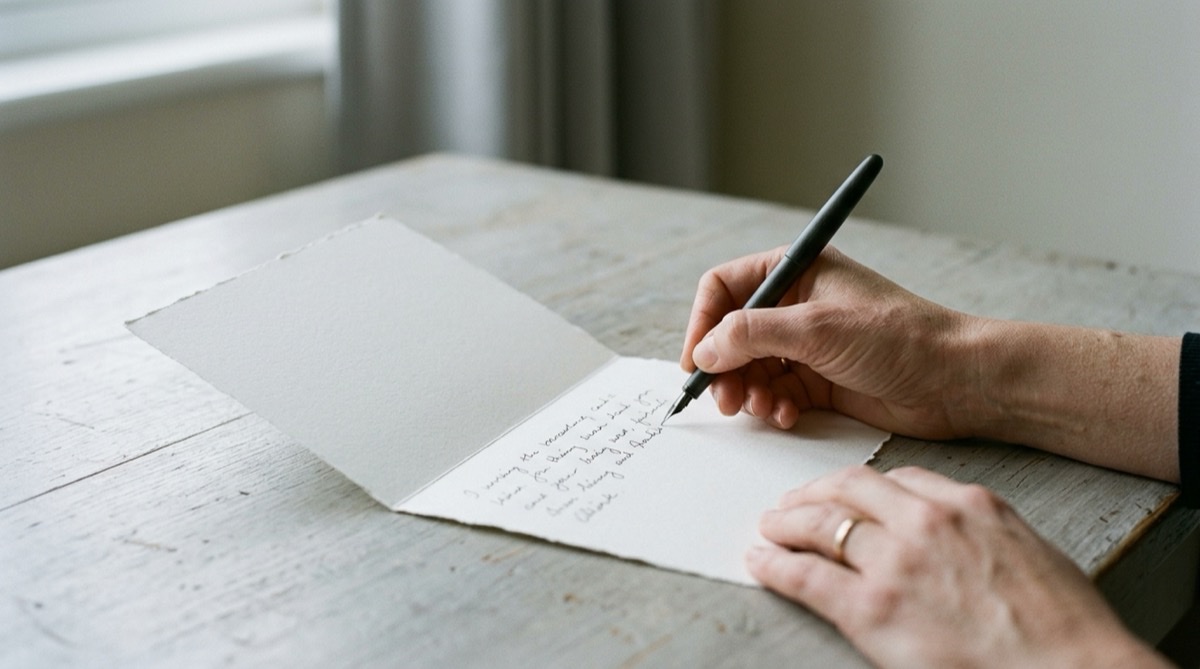
As a couple. Both first names, no surname if the family knows you well: With love, Anna and Mark. Add the surname if there is any chance of two Annas.
As a family. Sign for the household only if everyone in it knew the person who died. The Kowalskis is warm when all of you knew them and hollow when only one of you did. If your children knew them, use their names rather than "and family".
For a workplace. Add the department or team, because the family is placing names against a person they may only have heard about at dinner: With sympathy from all of us in the design team. If the card is going around the office, write your own line above your name rather than adding a signature to a row of signatures.
Should you write your full name?
Usually yes. The family is receiving dozens of cards in a week when grief is actively interfering with memory, and a first name alone can be genuinely hard to place. "Tom" is four people. "Tom Brennan, from the running club" is one.
Add three or four words of context if the connection is not obvious: how you knew the person who died. It saves the family a conversation they do not want to have.
Close family and lifelong friends are the exception. If they would recognise your handwriting, your first name is enough.
Signing when you barely knew them
Write less, and be honest about the distance. A short, plainly worded card from an acquaintance lands well. One reaching for intimacy it does not have is the kind people mention afterwards.
With deepest sympathy, Tom Brennan, your father's neighbour on Ash Road. That is a complete card. It tells the family who you are and that someone else noticed.
What to write in the line above your name
If the question is what to sign on a sympathy card beyond the closing itself, it is one short line before your name. Eighteen, all usable as they stand.
- I am so sorry.
- I am thinking of you today.
- I will be thinking of you in the weeks ahead, not only this week.
- There is nothing useful to say, so I will just say I am here.
- You are not alone in this.
- I am glad I knew him.
- I am glad I knew her.
- She mattered to a lot of people, and I was one of them.
- He mattered to a lot of people, and I was one of them.
- Take whatever time you need.
- No need to reply to this.
- I will call on Sunday; you do not have to pick up.
- I am bringing dinner Thursday; I will text before I come.
- I will be at the service.
- This is a real loss, and I am sorry it is yours.
- Please do not feel you have to manage this gracefully.
- I am not going anywhere.
- Thinking of your whole family.
Practical notes
Handwrite it. Even three lines in your own hand carry weight that printed text does not, and if the card has a printed sentiment inside, writing something of your own underneath changes it entirely.
Send it as soon as you hear. Within a week is ideal, within two is fine, and one arriving a month later still lands well; by then the first wave has passed. It is almost never too late.
When signing a card like this, use pen, not pencil. Cards like these are kept, sometimes for decades.
The card itself
Any card carries these closings: a shop-bought card, a notecard, plain stationery. Where a card is the whole gesture, that is usually enough; where the family is also marking a life later on, memorial photo gifts are the quieter end of that, and what optical crystal actually is explains what those keepsakes are made from. For completeness, ArtPix 3D makes 3D pop-up greeting cards that open to a layered scene and leave the inside blank for handwriting. They exist; a plain card and the right words do the same job.
Why trust ArtPix 3D
ArtPix 3D (ARTPIX, LLC) has made custom photo gifts in the USA since 2017, from a production facility at 2250 Arthur Ave, Elk Grove Village, IL 60007. The Trustpilot rating is 4.7 out of 5 from more than 63,800 reviews. We ask every customer for a review, positive or negative, and reply to every negative review within 24 hours. The phone number is +1 (855) 227-5861. Every order includes a free 3D preview you approve before production begins.
Frequently asked questions
How do you sign a sympathy card?
Match the closing to how close you were to the family. "With deepest sympathy" suits a business relationship or someone you barely knew; "With love" suits people you know well. Add your full name if the family may not place you immediately, and if you are signing for work, include your department.
What do you write above your name on a sympathy card?
One short line is enough. "I am thinking of you today" or "I will be thinking of you in the weeks ahead" both work without asking anything of the reader. Avoid closing with "let me know if you need anything"; name a specific offer instead, or say nothing beyond that you are there.
Do you sign a sympathy card with your full name?
Usually yes. The family may be opening dozens of cards while grief is interfering with recall, and a first name alone can be hard to place. Add three or four words of context if the connection is not obvious. Close family and lifelong friends are the exception, where a full name reads oddly.
How do you sign a sympathy card from a family?
Sign for the household only if everyone in it knew the person who died. "The Kowalskis" is warm when that is true and hollow when only one of you knew them. Name your children individually if they knew the person, rather than writing "and family", which reads as filler.
How to sign a sympathy card for a coworker?
Keep it brief and add your department, so the family can place you: "With sympathy from all of us in the design team." If a card is circulating the office, write your own line above your signature rather than adding a name to a row of names, which reads as a form.
Is "with sympathy" or "with deepest sympathy" better?
"With deepest sympathy" is marginally warmer and the more common of the two, and neither is ever wrong. "With sympathy" suits a card that is already warm in its wording. If you cannot decide, "With deepest sympathy" is the closing that fits the widest range of relationships.
Related from ArtPix 3D

20 Best Small Gifts to Let Your Dad Know You’re Thinking of Him
Best New Baby Gifts to Bring on Your First Visit
Top Notch Presents For A Pet Lover
10 Best Gift Ideas to Celebrate a Single Valentine’s Day